

Keep a Second Brain That Ships Work, Not Folders
A second brain is Tiago Forte's CODE loop, not four PARA folders. Distill is where it stalls. Cap weekly review at 30 minutes, then pick the app last.
Updated 18 min read

A second brain is Tiago Forte's CODE loop, not four PARA folders. Distill is where it stalls. Cap weekly review at 30 minutes, then pick the app last.
A second brain is an external digital store for what you learn, so your first brain can have ideas instead of filing them. Tiago Forte packaged the practice as CODE: Capture, Organize, Distill, Express. This is a personal knowledge workflow, not the enteric nervous system.
A standup already overflows working memory. PARA (Projects, Areas, Resources, Archives) is the folder overlay, the pantry you cook from.
The Distill stall is what most how-tos skip. Cap weekly upkeep at 30 minutes. Pick the app last.
Forte defines it as "an external, centralized, digital repository for the things you learn and the resources from which they come." The load-bearing line is older than the book. The Simon & Schuster excerpt of Forte's book opens with David Allen's close variant: "Your mind is for having ideas, not holding them."
Official BASB language is blunter. Information overload has long since become information exhaustion.
Frank Anaya, a former BASB Senior Mentor, draws the line most abandoned vaults never cross. Notes become a thinking environment the moment you retrieve from them instead of filing into them.
Every notes app can become one. Most stay dumps.
If you already run GTD, keep the split clean. The vault answers "what do I know?" GTD answers "what should I do next." They solve different problems and work better as a pair than as substitutes.
Maggie Appleton's illustrated notes still rank for the branded how-to. Her objection is the right one to answer: filling a "digital brain" as if it were a filing cabinet is unlikely to produce knowledge. Answer her with Distill and Express, not with more folders.
George Miller (1956) made "seven plus or minus two" famous. Cowan's 2001 reanalysis in Behavioral and Brain Sciences put adult working memory closer to four chunks.
Remote work makes the overflow visible. Slack, calendar, and an un-minuted decision arrive in the same hour. That is context switching with nowhere to park the residue.
Clark and Chalmers (1998) argued that a notebook you rely on, trust, and consult is functionally part of the cognitive system. Otto's notebook in that paper is the ancestor of a vault you actually open.
An external store is an extension you have to keep honest.
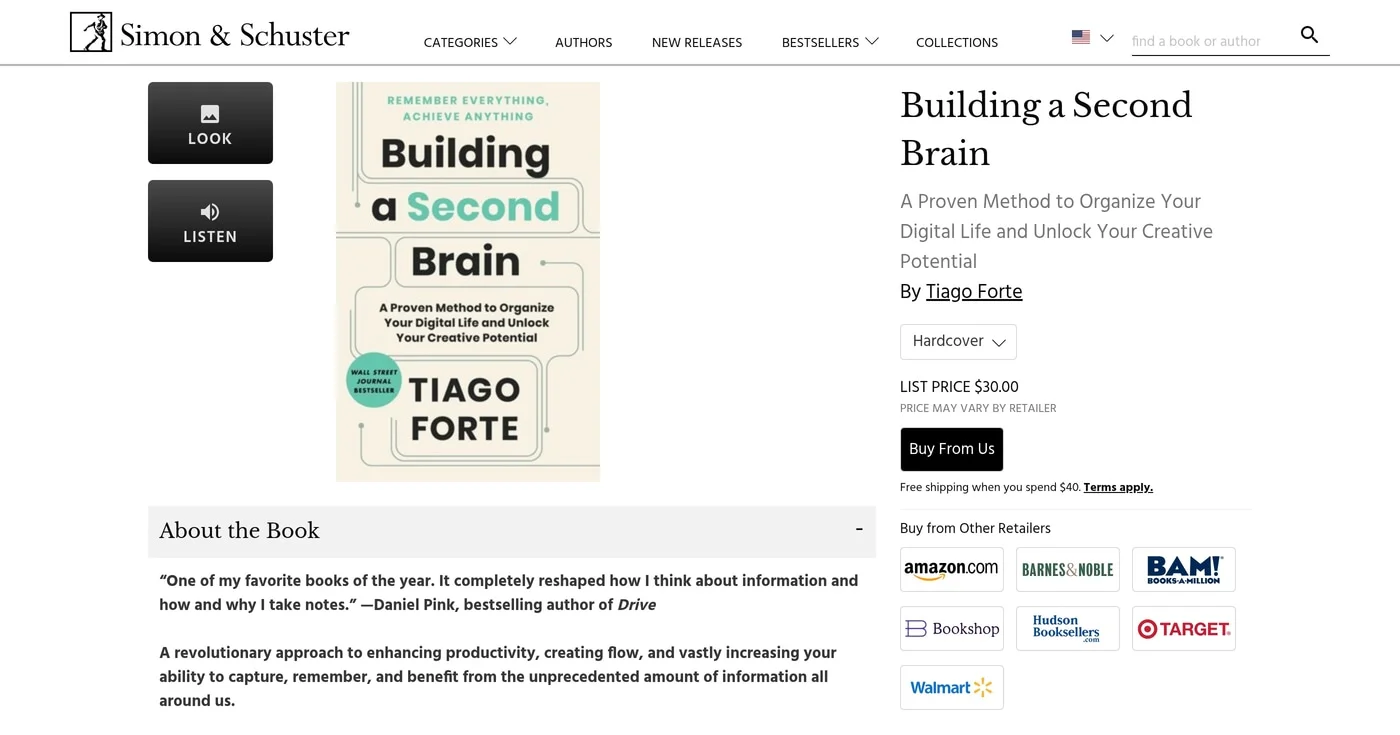
The 2022 book, Building a Second Brain (Simon Element / Simon & Schuster, 14 Jun 2022, 272 pages, hardcover $30), popularized the phrase.
Forte taught live BASB cohorts through early 2023, 6,000 students over six years, then stopped.
The 2026 rewrite still wants a system that gives you more energy than it takes to keep. That energy test is the one this guide keeps.
Searchers type "PARA vs BASB" as if they were rival products. Official Forte help already refuses that fight.
"Building a Second Brain is about the holistic creative process, from writing something down in the first place all the way to turning it into your own creation. One of the chapters in the book is dedicated to how to organize digital content using a technique I developed called PARA."
"Think of The PARA Method as the 'implementation guide' to your Second Brain."
Those lines sit on Forte's help article (25 Jul 2024). You can run PARA without the book. Four folders are not a finished system.
Iwo Szapar restates it as a kitchen. BASB is cooking: sourcing, prepping, seasoning, plating. PARA is how you arrange the pantry. zettelkasten.de puts the same split in one line: PARA is the storage system of BASB; CODE is the workflow.
Piece | What it answers | Stands alone? |
|---|---|---|
BASB | How do I capture and reuse knowledge over years? | Yes; includes a PARA chapter |
CODE | How does a saved item become shipped work? | No. It is BASB's cycle |
PARA | Where does this note go? | Yes, as a filing system |
CODE is a cycle. The next step should shape the current one. If a clip will never be expressed, you do not owe it a PARA palace.
Zettelkasten is a different animal: atomic notes linked for discovery, not action folders. zettelkasten.de's own line is that BASB is a cat and ZKM is a dog. You can use both. This guide does not retarget it.
How-to pages still collapse the branded query into four buckets and a Notion dashboard. Name that crowding, then ignore it. The four folders belong in Organize.
Four verbs. Each one has a time budget and a failure mode. Skip the app comparison until the jobs are clear.
Forte's official heading is selective: capture only the most important information. The tension underneath that heading is real.
Capture is the wrong moment to file. Organize and Distill are where you get picky.
Workflowy teaches four filters: inspire, useful, personal, surprising.
If none fire, leave it. Future you has to walk that pile.
The 2026 bottleneck is not which inbox you pick. Nadia Okafor (Apr 2026) named the Tuesday failure. You spend a weekend on a PARA dashboard, then capture four notes, two of them reminders to use the system, and fall back to Apple Notes.
The concept asks you to capture while you are already doing the job. Client restructures and Slack numbers arrive when capacity is lowest.
Forte said the same thing at Google, from the other side. Capture is now trivial. The bottleneck moved.
"The bottleneck on notetaking moves. It moves from the initial capture, which has now become trivial, and it moves to the subsequent steps." (Tiago Forte in Talks at Google, 24:38)
His own habit is the opposite of a clip-everything script.
"All my tricks, and my habits, and my strategies are mostly about limiting, trying to get myself to be more selective and picky and to capture less." (Tiago Forte in Talks at Google, 27:04)
Matt Giaro argues CODE starts after consumption and amplifies bad reading habits. Treat that as a preface, not a veto.
Decide what is worth ingesting, then keep capture to seconds. A one-line "why am I saving this" tax before the clip is enough. Do not turn capture into a second job.
On r/PKMS, the recurring problem is the unread-clip graveyard, not a missing folder.
"Capturing is too easy. Synthesis is too hard. I've clipped hundreds of articles I'll never read. Bookmarked YouTube videos I'll never watch. My inbox is basically a graveyard." (u/False_Care_2957 in r/PKMS, Dec 2025)
Organize by how you will use the note, not by topic tree. Forte's warning is the constraint: a system as complex as your life will rob you of time you need to live it. Four folders, on any platform.
Bucket | Definition | Examples |
|---|---|---|
Projects | Short-term efforts with a goal and an endpoint | Ship a landing page, write a report |
Areas | Ongoing standards with no end date | Health, finances, a team you manage |
Resources | Topics of ongoing interest | Pricing research, a craft you study |
Archives | Anything from the first three that went cold | Finished projects, dropped areas |
Forte's Progressive Summarization essay calls Archives cold storage. You do not tour it weekly.
Workflowy is blunt: organizing is not a full-time job. You will only actively use a tiny percentage.
Vera Calloway (29 Mar 2026) timed the failure: you open Notion to think and spend 20 minutes deciding which database a note belongs in. That is filing.
Use her diagnosis. Decline any ending that says an agent should own the vault for you.
Notion marketplace templates teach "vault = PARA dashboard." That is the collapse in product form. Forte's own resource guide splits styles: Architects tend toward Notion or Craft; gardeners who want files they own tend toward Obsidian or Roam.
"No perfect tool." Pick the app you can open today with the least hassle, then stay with it a few months.
On r/ObsidianMD, the upvoted Organize advice is overflow-driven, not schema-first.
"The only useful advice I ever saw was to not follow some structured approach, but to just start capturing the information you want. Once a folder gets too many notes, or a note gets too long, reorganise it into sub folders and topics." (u/professorkek in r/ObsidianMD, Oct 2025)
After PARA answers where packets live, Progressive Summarization answers how they are made so future you can discover them. Forte's 2017 essay (updated since) assumes that future you is impatient and wants proof up front.
Compression has a floor and a ceiling. Too compressed and the note is glanceable but meaningless in a year. Too much context and you spend a couple of hours deciding whether it is useful.
Forte's armor metaphor: safety versus weight. Do not add infinite layers.
Forte's own layers, from the 2017 essay and its follow-up:
Layer | What you do |
|---|---|
0 | The original source (the full article, book, or talk) |
1 | The excerpts you import |
2 | Bold the best parts of those excerpts on revisit |
3 | Highlight the best of the bold |
4 | Optional executive summary in your own words |
5 | Remix, if you actually reuse it |
Anaya's teaching goal is that future you absorbs the value in about 30 seconds. Forte at Google: you cannot work with an 11,000-word note; bold the key points.
Summarize a note every time you touch it, so layers track how integral it is. That is not a factory timetable.
The skip-rule is the one ranking guides omit. From the Pragmatic Mind glossary: if you never return to a note, one layer of highlighting is enough.
The method matches effort to actual use, not to completeness. Each pass should stay under a minute.
This is where most implementations stall. People capture well and never return.
Bake a short pass through recent notes into weekly review. Do not do all the work at capture.
zettelkasten.de's distinction: Progressive Summarization is a preparation method for resources, not a processing method for information.
Readwise Daily Review is Distill-as-a-streak. Name it as an alternate mechanic. It is not a replacement for knowing why the note exists.
Reddit's upvoted Distill fix is right-to-left. Name the output before you save.
"You're working Left-to-Right: Capture everything → Organize it perfectly → Hope value emerges. This inevitably leads to a graveyard because synthesizing without a destination is just endless fidgeting." (u/paralloid in r/PKMS, Dec 2025)
All the earlier verbs have one purpose: tangible results in the real world. Intermediate Packets are the unit.
A meeting note, a paragraph, a slide, talking points. Stop trying to move the entire project in one sitting.
Forte's 10 principles put two constraints on Express. Principle 7: break work into packets because motivation is scarce.
Principle 8: you only know what you make. Principle 10: systems that must be perfect to be reliable are deeply flawed.
Appleton's friendlier picture is mise en place. Notes sit between capture and delivery the way prepped ingredients sit between shopping and service.
Ask what the system should help you produce in the next 30 days. Too much structure early creates maintenance debt.
Giaro says Distill and Express are the same tasks twice. Distill is future you's 30-second glance; Express is shipped work. If a note will never be expressed, skip Distill.
Expression is a concrete artifact. It does not have to be a public essay. Forte's Google-talk sleep plan (walked in full later) has the same shape: a long dump, a ten-second file, bolding, then a one-page artifact someone could use that night.
2026 vendors rewrite Express as handing the library to an agent. The official Readwise MCP is that retrieval layer. Express is still a human packet until you choose an agent.
Head-term and how-to pages walk Capture and four PARA folders. Progressive Summarization only ranks when you already know the phrase, and the winners are Forte's 2017-18 posts.
The stall has a shape. You clip on the phone between meetings, then never reopen the note because there is no destination.
u/JeffB1517 in r/PKMS put the cost in one sentence: the tools allow you to organize, they do not organize for you, and capturing more makes the problem worse.
Outcome-first Distill is the rule that survives a real calendar.
Focus techniques help you protect the Distill pass. They do not replace it.
Search is not Distill either. Nick Milo cut a 13,000-note search for "lyt" from 22 seconds to 2 (Aug 2025).
Faster retrieval is useful. It does not tell you which sentence still matters.
Frank Anaya named the failure: system maintenance as productivity theater. Three hours reorganizing PARA folders, building a dashboard, installing plugins, and zero finished work.
If you spend more time managing the system than working in it, reduce it until it disappears as a chore. Copying someone else's YouTube architecture wholesale is, in his words, genuinely destructive.
Forte's own weekly review is the clock. The One-Touch Guide promises chaos to clarity in 30 minutes.
The budgeting analogy in that post is 15-30 minutes per week. Anything larger he calls totally crazy, a life overhaul disguised as a review.
His anti-pattern is Google Maps recalculating a new destination every five seconds. His order is the same every time: Email, Calendar, Desktop/Downloads, Notes, Tasks.
Funnel actions down. Do not rebuild the system.
Budget | Source | Use |
|---|---|---|
30 minutes | Forte, Weekly Review | Primary BASB budget |
15-30 min/week | Same Forte post (budgeting analogy) | Hard cap. Hours = overhaul |
About one hour | Julia Saxena (Apr 2022) | Practitioner range |
About one hour | Adjacent method. Label it GTD | |
20 minutes choosing a database | Vera Calloway | Failure-mode clock |
Seconds per capture | Forte | Capture SLA |
Under 1 minute per Distill pass | Distill SLA |
The best setups are low-maintenance by design. An inbox, a few project folders, and an archive.
Weekly effort in minutes, not hours. If the system needs a dedicated maintenance session just to stay functional, it is overengineered. Start in 15 minutes with a tool you already have.
Simon Swanson abandoned his: the vault was sucking time and energy out of his primary brain. He never referenced it. If first-brain recall is faster than search, ROI is negative.
Do a time audit on the vault the same way you would on a calendar. If review never produces a shipped packet, delete until it does.
kepano's May 2025 migration is Organize debt in the wild. He translated about 3,000 Dataview queries into 30 Bases so the vault stayed maintainable.
Migrated my personal vault to Obsidian Bases and it feels so good 🥰 I was able to translate ~3,000 dataview queries into 30 bases. Makes for a more maintainable approach to bottom-up notetaking. https://t.co/cjxBZhrfPZ
On r/ObsidianMD, the branded phrase often reads as marketing. The working stance is a tool you pick up when there is a screw.
"I have a screwdriver. I don't carry it around, spending my days searching for screws to adjust, logging each tighten/loosen event so I can measure my screw-driving acumen and assess my worth. I use my screwdriver when I need to adjust a screw. I use Obsidian when I need to take a note." (u/FrankensteinJones in r/ObsidianMD, Oct 2025)
Weekly confrontation with what matters is the unpaid cost. Budget minutes for it. Do not budget a hobby.
How you work with software is what produces a second brain, not a particular app that looks a particular way (Forte at Google, 29:01). Apps SERPs are affiliate lists.
This section maps jobs to formats. It is not a ranking.
Job | Format | Named examples | Trap |
|---|---|---|---|
Capture | Fast inbox or clipper | Readwise Reader, Evernote, Obsidian Web Clipper, Workflowy | Making capture a second job |
Organize | Database vs files you own | Ranking them, or titling the vault on a template | |
Distill | Layers vs streak | Progressive Summarization vs Readwise Daily Review | Skipping Distill because search exists |
Express | Artifact, then maybe an agent | Human packet, optional Readwise MCP | Letting chat replace shipped work |
Obsidian is local-first markdown. The app is free without limits.
Optional Sync is $4/user/mo billed yearly. Graph view and plugin weekends raise upkeep. Say that out loud before you install a pack.
Notion Plus is $10/member/mo; Business is $20. Marketplace crowding is how PARA-as-the-whole-system gets sold.
Use Notion if you already think in databases. Do not start there because a YouTuber handed you a dashboard.
Readwise Lite is $5.59/mo billed yearly; Full is $9.99. Daily Review is the Distill streak.
Workflowy Pro is $6.99/mo billed yearly. Evernote still teaches dump-then-search. Official compare-plans pages do not publish stable dollar amounts worth citing here.
kepano's bet on agents is files you own, in plain text.
AI agents built into cloud apps will always be sub-par compared to state of the art agents that you can use with Obsidian. This is because your Obsidian data is in your control, in plain text formats that are ideal for LLMs to process. You can choose to run any of the https://t.co/pLwxg29m9w
Kevin Moody on LinkedIn named the Organize tax vendors like to sell past: most tools expect you to organize everything yourself (Oct 2025). That tax is real.
Auto-file is a faster graveyard unless Distill has a destination.
Start with whatever you can open without friction. Apple Notes and OneNote are valid first homes.
Switch later if the format fights the job.
ChatGPT made old live-cohort advice feel obsolete, Forte wrote in AI Second Brain (March 2026). Agent harnesses can read files and take action. The "digital confidant" in the 2022 book is no longer only a metaphor.
The same post still wants a system that returns more energy than it consumes. That sentence outranks the product.
Cole Medin (2026) is the failure mode to design against. Append-only agent wikis rot. In his demo, memory.md stayed stuck at a $4,000 monthly retainer after later logs had moved it to $6,000 and $9,500.
"Your second brain is probably rotting as we speak. AI brains, they decay just like human brains do." (Cole Medin, 0:58)
Split state (can go stale) from events (timestamped history). Do not ask a chat window to be the archive.
In 2026 your notes have a second reader. Write enough context that retrieval works for you and for a model.
That raises the payoff of a kept system. It does not replace CODE. Szapar's kitchen still does not collapse into the pantry because an agent can file.
LinkedIn company pages sell the app as the method. Progressive Summarization never appears.
If you only listened there, CODE would look like Capture plus Search. Keep Distill.
These five fail in the same way: the vault gets more ceremony while shipped work stays flat.
You install four buckets, a gallery view, and a branded title. Capture still happens in Apple Notes on Tuesday.
Official help already says PARA is the implementation guide, not the creative process. Build CODE first. Folders second.
Left-to-right clipping produces the r/PKMS graveyard. Name the project, page, or decision before you save.
If you cannot, one inbox line is the whole note. Synthesis without an output is fidgeting.
Marking every old clip to "catch up" is how Progressive Summarization dies. If you never return, one layer is enough.
Touch notes when you use them. Skip the rest.
Multi-hour reviews are what Forte calls totally crazy. If upkeep takes an afternoon, delete plugins, collapse folders, and stop re-architecting. Minutes, or the system is the hobby.
Anaya's warning: wholesale copies of YouTube or Notion architectures are genuinely destructive. Imperfect system you use beats a perfect system abandoned after three weeks. Reverse-engineer from your next 30 days of output, not from a screenshot.
The Talks at Google walkthrough is still the cleanest CODE demo that is not a SaaS homepage.
He captured a long dump from a sleep book. Organize took about ten seconds: the note moved into a project folder.
Distill was bolding, not a rewrite. Express was a one-page sleep plan tacked to the wall outside his son's bedroom door.
Later it became a blog post. The artifact was physical first.
That sequence is the opposite of a weekend dashboard. Capture stayed cheap.
Organize did not become a database design session. Distill happened because he touched the note for a real output. Express was something a person could use the same night.
Use that as the acceptance test. If this week's vault work produced no packet (a plan, a paragraph, a decision log, a slide), you did maintenance theater. Cut until a packet appears.

Build a working email management system: 2-3 check windows, a filter policy for CCs, canned replies that close loops, and when a thread should leave the inbox.

Work life balance for remote and hybrid workers is a stop condition, not a 50/50 split. Boundary scripts, the always-on trap, and employer-owned constraints.
Parkinson's Law: work expands to fill the time you give it. Set calendar-real deadlines, shrink meeting defaults, then price the hours those slots cost.
