On a radiant Monday in late June 2024, Cal Newport's schedule held two hours of book writing, three hours of podcast prep and recording, a 30-minute meeting, and a two-hour interview with EL PAÍS. By around 4:30 p.m., he was done.
No late nights. No weekend catch-up. No inbox lingering open in a second browser tab.
This is not a story about a man who works less. It is a story about a Georgetown University computer science professor who has spent nearly two decades arguing that most knowledge workers think about time all wrong. He has sold more than 2 million books trying to fix it.
Key Takeaways
- Cal Newport is a full professor of computer science at Georgetown University and the author of eight books, including multiple New York Times bestsellers
- He popularized "deep work": focused, uninterrupted concentration on cognitively demanding tasks, free from email and social media
- His books, including the Technology and Society trilogy (Deep Work, Digital Minimalism, A World Without Email), have sold more than 2 million copies combined and been translated into over 40 languages
- His 2024 book Slow Productivity argues that modern knowledge work is built on a broken definition of productivity and offers a three-principle framework to fix it
- He has never had a social media account, though he tried TikTok as a 2025 New Yorker experiment
- His next book, The Deep Life: A Structured Approach, is due from Portfolio on March 2, 2027
Who Is Cal Newport?
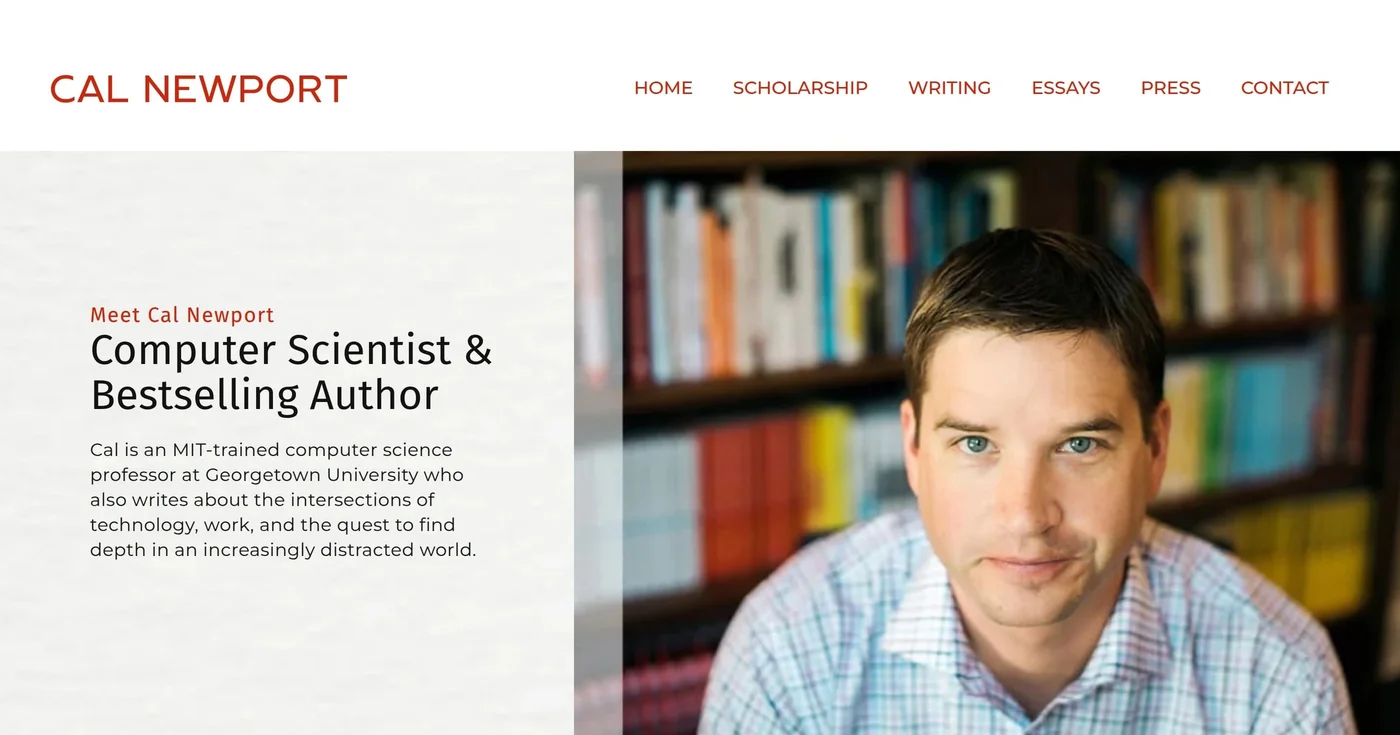
Calvin C. Newport was born in Houston on June 23, 1982, and moved to New Jersey at age seven. He grew up in Pennington, New Jersey, near Princeton University.
His grandfather, John Newport, was a Baptist theologian and scholar. His mother was a computer programmer.
Growing up near Princeton, Newport discovered what he called "the world of ideas." He was also drawn to software, starting a company with a friend while still in high school.
He signed his first book deal with Random House just after his 21st birthday, while still an undergraduate at Dartmouth College. The book was student advice. So were the next few.
He finished his undergraduate studies at Dartmouth in 2004 (summa cum laude) and earned his PhD in computer science from MIT in 2009. In 2011, he joined Georgetown as an assistant professor.
"I grew up in the era of the software barons, the age of Microsoft's ascent… I was adept at technology."
– Cal Newport (EL PAÍS, 2024)
In 2012, So Good They Can't Ignore You challenged the most popular career advice of its era: "follow your passion." Newport argued the opposite: passion follows mastery, not the other way around. It set up the argument he would make next.
The Work That Changed Everything
In 2016, the year before Georgetown granted him tenure, Newport published what would become his defining book: Deep Work: Rules for Focused Success in a Distracted World. It has since sold more than 1.5 million copies.
The core argument is deceptively simple. As Newport explains it:
"Deep work is a type of effort where you're giving full concentration without distraction on something cognitively demanding. The opposite of deep work (non-deep work) is where either the work is easier, or your mind wanders. You're working on it, but you're also checking something else. You're thinking about the book chapter, but you're also looking at your phone or jumping over to see what's happening on email. I call that shallow work."
– Cal Newport (Writers Digest, 2025)
What made the book hit differently from other productivity guides was Newport's refusal to treat distraction as a willpower problem. He framed it as a structural one. Modern workplaces, he argued, had been redesigned around tools like email and Slack that made shallow work the default, and deep work increasingly rare.
Yet the most valuable outputs in knowledge work (original research, persuasive writing, complex software, creative strategy) require exactly the kind of sustained concentration that those tools destroy.
His solution was practical: time blocking. Newport plans how he will spend each workday in advance and then follows the plan, assigning blocks to specific tasks rather than letting work arrive reactively through an inbox.
Three years later, Digital Minimalism (2019) extended the argument from the workplace into daily life. Newport proposed a philosophy he called digital minimalism: focus your online time on a small number of carefully selected activities that strongly support things you value, then miss out on everything else. He had made a sharper version of that case in a 2016 TEDx talk, "Quit Social Media," which went viral.
Newport was not a Luddite making the argument. He was a computer science professor, and he had never had a social media account. In December 2024, while recovering from surgery, he downloaded TikTok to test his decade-old arguments for a New Yorker column.
In the book, Newport quotes comedian Bill Maher's May 12, 2017 monologue on HBO's Real Time:
"The tycoons of social media have to stop pretending that they're friendly nerd gods building a better world and admit they're just tobacco farmers in T-shirts selling an addictive product to children. Because, let's face it, checking your 'likes' is the new smoking."
– Bill Maher, quoted in Digital Minimalism (Goodreads)
A World Without Email followed in 2021, targeting the hyperactive hive mind of modern offices: the constant, context-switching churn of inbox and Slack that leaves knowledge workers perpetually reactive and rarely focused. Newport became a contributing writer at The New Yorker the same year, adding long-form journalism about technology and society to an already crowded plate.
The Impact: Rewiring How Remote Workers Think About Time
For remote professionals, Newport's work arrived at precisely the right moment. As distributed teams multiplied and the boundaries between work and home dissolved, the pseudo-productivity trap he described became more acute, not less. Being visibly active on Slack at 9 p.m. became the new version of looking busy at your desk.
GQ called Newport "something of a modern workplace ombudsman." His books do not just describe a problem. They provide a vocabulary for something workers already felt but could not name: that frantic busyness and genuine productivity are not the same thing.
Attention research backs him up. UC Irvine informatics professor Gloria Mark reports that people spend an average of just 47 seconds on any one screen before shifting their attention. It can take up to 25 minutes to return to a project after an interruption.
Newport himself puts the cost of a quick inbox glance at 15 to 20 minutes of lost focus on a difficult task.
"The true productivity poison in the modern workplace or educational environment are the quick checks of unrelated sources of information that create that persistent state of divided attention. This not only reduces our cognitive capacity but is also exhausting. Both our work and our mental health suffer."
– Cal Newport (Georgetown University, 2024)
For knowledge workers who want to reclaim their time, Newport's time blocking method offers a practical starting point. The principle is straightforward: before your workday begins, plan it in blocks.
Assign blocks to specific tasks. Protect those blocks from reactive requests. Treat the schedule as a commitment, not a suggestion.
That framework resonates with remote and async workers, who often lack the structural guardrails of an office and must build their own rhythms. Newport practices the limits he preaches: in the evenings he turns off the computer, and he rarely works on weekends.
Writer and reviewer Anne Janzer, who read an advance copy of Slow Productivity, put it directly: "Cal Newport's new book Slow Productivity bucks the trend. The book delivers Newport's usual blend of thought-provoking content and relevant research and stories. I did not expect the sustained, positive impact it would have on my life."
Newport's academic output has kept pace with his public writing. He holds a full professorship at Georgetown (promoted in 2024) with over 65 peer-reviewed articles, cited more than 4,500 times, mostly on the theory of distributed systems. His 2022 paper on information spreading in dynamic networks won the Best Paper award at the International Symposium on Distributed Computing (DISC).
Slow Productivity and What Comes Next
Newport's 2024 book Slow Productivity may be his most ambitious attempt yet to reframe knowledge work from the ground up. The argument: knowledge work adopted a broken definition of productivity. Lacking any equivalent of the manufacturing ratios that drove industrial output, workers defaulted to visible busyness as a proxy for real effort.
"We do what I call pseudo productivity, which uses activity as our main proxy for useful effort. This doesn't work. It just burns us out, we go faster and faster, we go shallower and shallower and very little of value actually gets done."
– Cal Newport (RNZ, 2024)
His prescription is three principles: do fewer things, work at a natural pace, obsess over quality. Each principle has historical grounding (Newport draws on the habits of Galileo, Isaac Newton, Jane Austen and Georgia O'Keeffe, among others) and practical application for contemporary workers.
Slow Productivity, published on March 5, 2024, became a New York Times, Washington Post and USA Today bestseller. Press coverage landed in the Financial Times, EL PAÍS, and the Boston Globe.
Beyond books, Newport continues to produce the Deep Questions podcast and publishes regularly on TheDeepLife.com, a portal he launched in fall 2022 to organize his video, podcast, and newsletter content. The Study Hacks blog, which he has run since 2007, draws more than 2 million visitors a year, and his weekly newsletter has more than 100,000 subscribers.
He continues to write for The New Yorker, where his long-form work has examined the workings of large language models. Few writers on AI pair a computer scientist's training with prose this plain.
In the 2024 EL PAÍS interview, Newport said his next book would carry Slow Productivity's ideas "beyond work, to life in general." The next title on his publisher's list is The Deep Life: A Structured Approach, due from Portfolio on March 2, 2027.
Its framework asks readers to discover what resonates, create a compelling vision, and execute a systematic plan, building a deeper life one deliberate change at a time rather than through one radical leap.